Acupuncture Research and Evidence
At Acubody, we believe that people considering acupuncture should have access to clear, balanced information about the research behind it. Scientific evidence can help us understand which treatments are effective, where potential benefits have been identified, and where important questions remain unanswered. This page explains how to interpret acupuncture research, what the evidence tells us about treatment, and where you can find high quality independent sources to explore the findings for yourself.
In short
- Evidence varies by condition. Research supports acupuncture for some applications more strongly than others.
- Study quality matters. A positive finding does not necessarily mean that a treatment has been proven effective.
- Research remains mixed. Some studies report promising results, while others find no significant difference from sham or standard care.
- Personal experience is not the same as clinical evidence. A practitioner’s experience can inform treatment, but it cannot establish effectiveness on its own.
- We encourage informed decisions. Research should be considered alongside appropriate medical advice, individual circumstances and realistic expectations.
What do we mean by scientific evidence?
Scientific evidence is information gathered through systematic investigation to help answer questions about health and treatment.
Different types of research provide different levels of confidence. Some studies explore whether a treatment might have an effect, while others investigate whether that effect is consistent, clinically meaningful and attributable to the treatment itself.
When assessing acupuncture research, it is important to consider not just whether a study reports a positive or negative result, but also how the study was conducted, how many people participated, what the treatment was compared with, and whether other researchers have found similar results.
A single encouraging study may justify further investigation. Consistent findings across several well-conducted studies provide a stronger basis for conclusions.
What is the evidence pyramid?
The evidence pyramid is a visual way of explaining the relative strengths and limitations of different types of research.
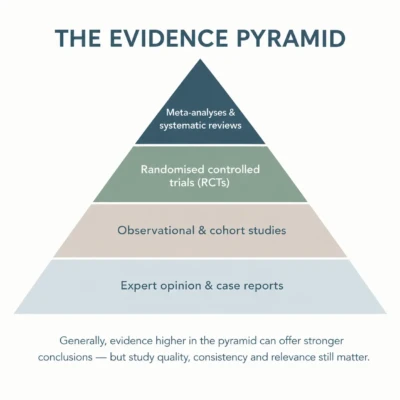
1. Systematic reviews and meta-analyses
These studies bring together findings from multiple research studies addressing a particular question.
A systematic review uses a defined method to identify and assess relevant research. A meta-analysis may combine numerical results from several studies to estimate an overall effect.
These methods can provide strong evidence when the underlying studies are sufficiently reliable and comparable. However, combining poor-quality or inconsistent studies does not automatically produce a reliable conclusion.
2. Randomised controlled trials
Randomised controlled trials (RCTs) allocate participants to different treatment groups using randomisation. Researchers may compare acupuncture with sham acupuncture, another treatment or usual care.
Well-designed trials can help determine whether observed differences are likely to be attributable to the treatment being studied.
In acupuncture research, results can be influenced by the choice of comparison group, the treatment protocol, the number and timing of sessions, and the outcomes measured.
3. Observational studies
Observational studies examine what happens to people receiving particular treatments without researchers randomly assigning those treatments.
They can help identify patterns, explore potential benefits and generate questions for further research.
However, it can be difficult to separate the effects of treatment from other factors, such as differences in health, lifestyle, additional treatments or the reasons people chose acupuncture.
4. Expert opinion and case reports
Practitioners may develop valuable clinical experience through treating individual patients over many years. Case reports describe individual experiences, while expert opinion draws on professional knowledge and interpretation.
These sources can help identify possible treatment approaches and questions worth investigating.
However, individual experiences cannot establish whether a treatment caused an improvement. Symptoms may change naturally, other treatments may contribute, and some patients improve without a specific intervention.
An important qualification: The pyramid is a guide, not an automatic ranking of truth. Study design, risk of bias, consistency, relevance and the certainty of the findings all matter. A well-conducted individual trial may provide more reliable information than a systematic review of weak or highly inconsistent studies. And a large scale cohort study might reveal more useful real world effectiveness information than a sham controlled RCT.
What is the difference between efficacy and effectiveness?
These terms help explain why research findings can differ from what people experience in practice.
Efficacy concerns whether a treatment works under controlled research conditions.
Effectiveness concerns how well a treatment works in real-world practice, where people have different circumstances and may receive other treatments at the same time.
Acupuncture research faces particular challenges because acupuncture is not a single, identical intervention. Treatment approaches, selected points, session frequency and individualisation can vary.
A clinical trial tests a particular treatment protocol in a particular group of people. Its results cannot automatically be applied to every acupuncture treatment or every patient.
It is still possible for a real-world effectiveness trial to be a randomised control trial in for instance a situation where acupuncture is compared with the standard care approach as in the cochrane review on post operative nausea and vomiting, or the trial comparing acupuncture with counselling or usual care for depression.
This does not mean that negative trial results should be dismissed because the treatment was different from what a practitioner normally provides. Both positive and negative findings need to be considered when assessing the overall evidence.
What about placebo effects?
A placebo is an inactive or simulated intervention used as a comparison in research. In acupuncture studies, researchers may use sham needling or another comparison procedure, depending on the question being investigated.
A placebo-controlled trial can help determine whether acupuncture produces effects beyond those associated with the comparison intervention.
However, designing a convincing sham acupuncture procedure is challenging. A simulated treatment may not be completely physiologically inactive, and participants may be able to distinguish between the treatments.
In fact some research has found that both acupuncture and ‘sham’ acupuncture can outperform standard care (Pubmed), and that so called placebo or sham acupuncture is not at all inert therefore cannot be considered a placebo in the same way as an inactive sugar pill (Pubmed). They argue that applying a method that was designed for pharmacological medicine cannot be meaningfully applied to what is a complex body treatment.
Whereas comparing the effects of acupuncture to other, more accepted complex interventions like counselling, physiotherapy, osteopathy, psychotherapy, or even surgery might give us more useful real world information. Researchers must therefore consider the strengths and limitations of the comparisons being used.
It is also important to distinguish between a specific treatment effect and the broader experience of receiving care. Time with a practitioner, the therapeutic relationship, expectations and the opportunity to relax may all influence how someone experiences treatment.
Some studies report positive findings, while others do not. Differences in research methods, generic treatment protocols and interpretation bias can make it difficult to draw firm conclusions. It is my opinion that RCT’s comparing the efficacy of different interventions are more useful than those employing an attempt at placebo-control.
For example Acupuncture may be chosen as a complementary therapy for personal wellbeing, including during a potentially stressful fertility journey. Some medical professionals see acupuncture as helping blood flow and improving outcomes and endorse acupuncture alongside reproductive treatment. However, others don’t believe it to be helpful over stress relief and a placebo effect.
How do we assess the strength of evidence?
The British Acupuncture Council (BAcC) has published guidance on presenting research and discussing the evidence for acupuncture responsibly.
Its November 2022 Guide to Advertising: Presenting the Evidence describes four levels for classifying the strength of evidence associated with different conditions:
Level 1 — Evidence of positive effect
Research supports a positive effect for the condition or application being assessed.
Level 2 — Evidence of potential positive effect
Research indicates a possible benefit, but the evidence is not sufficiently conclusive to establish the effect with the same confidence.
Level 3 — Unclear or insufficient evidence
The available research does not allow a clear conclusion to be reached.
Level 4 — No evidence of effect
The evidence assessment indicates no demonstrated effect for the application being considered. This can mean that no good quality research has been done on a particular condition.
These categories concern the evidence for a particular condition; they should not be confused with the types of research shown in the evidence pyramid.
They also require careful interpretation. An absence of convincing evidence is not necessarily proof that an intervention can never have an effect. Equally, preliminary positive findings are not proof that it does.
The British Acupuncture Council document cited here was published in 2022. Evidence classifications can change as new research is published, so condition-specific assessments should be checked against current sources rather than assumed to remain unchanged.
Where can I find independent acupuncture research?
We encourage readers to consult independent organisations and published research rather than relying solely on information provided by treatment providers.
The following resources offer useful starting points.
British Acupuncture Council
The BAcC provides information about acupuncture research and evidence summaries covering a range of health conditions.
Its resources discuss the interpretation of research and the challenges involved in evaluating acupuncture studies.
The Cochrane Library
Cochrane produces systematic reviews of healthcare interventions using structured methods to assess available research.
Its review of acupuncture and assisted conception examines evidence relating to pregnancy and live birth outcomes.
PubMed
PubMed is a database of biomedical research maintained by the US National Library of Medicine.
It provides access to citations and abstracts for published studies, including randomised controlled trials, systematic reviews and meta-analyses.
The National Institute of Health (NIH)
The NIH is an institution in the United States which is focused generating knowledge living systems in order to enhance health, lengthen life and reduce disability and illness.
The National Centre for Complementary and Integrative Health (NCCIH) has a resource summarising the research here.
Evidence Based Acupuncture (EBA)
This online resource has accessible summaries of the research all fully referenced that you can browse and search to get a feel for the amount of evidence there really is in specific areas.
When reading a study, look beyond its headline conclusion. Check the number of participants, the comparison group, the outcomes measured, the limitations identified by the authors and whether the findings have been replicated.
How does research inform treatment at Acubody?
Research is an important part of making informed decisions about healthcare. It helps us understand the limits of what is known, identify promising areas for further investigation, clear communication with patients and to avoid making claims that go beyond the evidence.
At Acubody, individual treatment decisions also take account of a person’s symptoms, health history, preferences and existing medical care. Other ways of looking at the body may be combined with acupuncture and traditional Chinese medicine theory in your treatment plan. For example we apply knowledge of the fascial system and biomechanics (much of which has its own research paradigm) to the treatment of musculoskeletal problems along with established pain science and rehab techniques.
Traditional Chinese medicine uses its own diagnostic framework to understand patterns of symptoms and individual differences. This framework informs the selection of treatment, but traditional diagnostic concepts should not be mistaken for independently established biomedical explanations of how acupuncture works.
Clinical experience can help guide conversations about treatment, but it is not a substitute for controlled research, but they give us different kinds of information. Similarly, one individual’s improvement after treatment does not guarantee that another person will experience the same result.
Our aim here, is to discuss potential benefits and limitations openly, support informed choice and encourage appropriate medical assessment where needed.
A note on safety
Acupuncture is considered low risk when performed by a suitably trained practitioner using appropriate techniques and sterile, single-use needles. Temporary soreness, bruising or minor bleeding can occur, and more serious complications are possible, although rare.
Tell your practitioner about relevant medical conditions, medication and any other ongoing treatment. Chinese herbal medicines may interact with prescribed medicines or be unsuitable during pregnancy or if you have certain other conditions like liver disease. It’s a good idea to communicate with your clinician before starting herbal treatment if any of this applies.
This page is intended to explain the research, not to provide individual medical advice or guarantee treatment outcomes. Evidence changes as new studies are published.